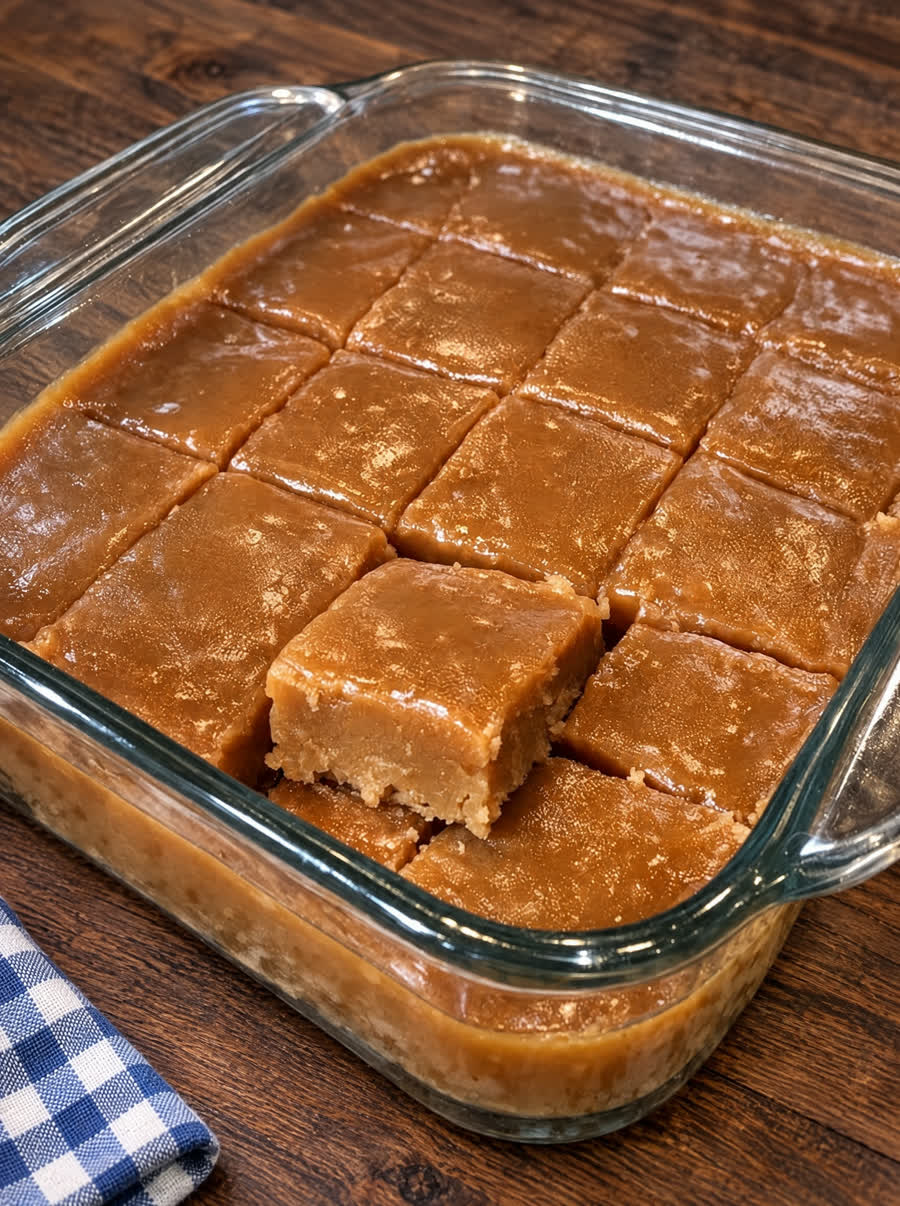
Depression era caramel fudge is an old-fashioned candy made from just brown sugar, milk, butter and vanilla, cooked to the soft-ball stage and beaten until thick and creamy. It tastes like a soft, melt-in-your-mouth caramel with a light fudge texture. There is no chocolate and no condensed milk, only pantry staples and a little patience at the stove.
My great aunt made a pan of this whenever company was coming, and she always said it was the candy her own mother made when money was tight. I made a batch yesterday afternoon just to see if it tasted the way I remembered. By dinner the dish was empty, and my teenager was scraping the corners with a butter knife.
Families in the 1930s leaned on recipes like this because brown sugar, milk and butter were often all they had. What surprises people is how rich it tastes. The brown sugar brings its own molasses notes, so the fudge comes out with a deep, toasty caramel flavor that store-bought candy rarely has.
The secret is all in the timing. Cook it to the right temperature, let it rest, then beat it until the shine just starts to fade. Miss that window and it either stays sticky or turns crumbly, so I will walk you through exactly what to look for.
Here is how it looks at each stage. While the sugar dissolves, the mixture is grainy and pale tan. Once it boils, it turns smooth, glossy and darker, with big lazy bubbles. After resting off the heat, it feels warm but no longer scalding. When you start beating, it is shiny like caramel sauce. A few minutes later it suddenly thickens, the spoon leaves a trail, and the surface turns from glossy to satiny. That is your cue to pour, and you need to move fast because it sets quickly from there.
Why You’ll Love This Old-Fashioned Fudge
- Four ingredients. Brown sugar, milk, butter and vanilla.
- No chocolate needed. The flavor is pure caramel and brown butter.
- Inexpensive. A whole pan costs very little to make.
- Great for gifting. Small squares look lovely in a tin or on a cookie tray.
- A piece of history. It is a fun recipe to make with grandkids and share the story behind it.
Ingredients
- 2 cups packed brown sugar
- 1/2 cup whole milk
- 4 tablespoons butter, plus extra for greasing the pan
- 1 teaspoon vanilla extract
Ingredient Notes & Substitutions
Brown sugar. Light brown sugar gives a classic butterscotch color. Dark brown sugar makes a deeper, more molasses-heavy fudge that is a touch softer. Pack it firmly into the cup when measuring.
Milk. Whole milk gives the creamiest result. Evaporated milk works well and makes it slightly richer. Skim milk is not a good idea here because the fudge can turn grainy.
Butter. Salted or unsalted both work. Salted butter gives a gentle salted caramel taste that I really enjoy.
Vanilla. Pure vanilla is best. For a twist, swap a quarter teaspoon of it for maple extract.
| Swap | Result |
|---|---|
| Dark brown sugar | Deeper flavor, softer set |
| Evaporated milk | Richer, extra creamy |
| Maple extract with vanilla | Maple caramel flavor |
| 1/2 cup chopped pecans | Praline-style crunch |
Equipment
- Heavy-bottomed 2 to 3 quart saucepan
- Candy thermometer (helpful but optional)
- Wooden spoon
- 8-inch square pan or small glass baking dish
- Small bowl of cold water for testing
How to Make Depression Era Caramel Fudge
- Butter an 8-inch square pan or small glass baking dish and set it close to the stove.
- Put the brown sugar, milk and butter in a heavy saucepan over medium heat.
- Stir gently until the butter melts and the sugar dissolves, about 3 to 4 minutes.
- Clip on a candy thermometer and bring the mixture to a gentle boil.
- Cook, stirring often, until it reaches 234 to 240°F (112 to 116°C), about 8 to 12 minutes. Without a thermometer, drop a little into cold water. It should form a soft ball that flattens when you lift it out.
- Take the pan off the heat and stir in the vanilla.
- Leave the fudge alone for 5 to 10 minutes to cool and thicken slightly.
- Beat hard with a wooden spoon for 3 to 5 minutes, until it loses some of its gloss and looks thick and creamy.
- Quickly scrape it into the buttered pan and smooth the top.
- Let it cool completely at room temperature, about 2 hours, then cut into 16 squares.
Tips for Smooth, Creamy Fudge
- Use a heavy pan. Thin pans create hot spots that scorch the sugar.
- Leave the sides alone. Once it boils, do not scrape the crystals from the sides of the pan back in. They can make the whole batch grainy.
- Test your thermometer. Place it in boiling water. It should read 212°F at sea level. Adjust your target if it is off.
- Watch the shine. Stop beating the moment the surface turns from glossy to satiny. Spread it right away.
- Cut with a warm knife. Dip a sharp knife in hot water and wipe it dry between cuts for clean squares.
Variations
- Pecan praline fudge: Stir in 1/2 cup toasted chopped pecans after beating.
- Salted caramel: Sprinkle flaky sea salt over the top before it sets.
- Maple fudge: Use 3/4 teaspoon vanilla and 1/4 teaspoon maple extract.
- Peanut butter swirl: Drop small spoonfuls of peanut butter on top and swirl with a knife.
Storage & Make-Ahead
This fudge keeps well, which makes it a nice candy to make ahead for holidays. Layer the squares between sheets of wax paper so they do not stick together.
| Where | How long | Notes |
|---|---|---|
| Airtight tin, room temperature | Up to 1 week | Best texture |
| Refrigerator | Up to 2 weeks | Firmer; let it sit out 15 minutes |
| Freezer, well wrapped | Up to 3 months | Thaw in the wrapping to avoid moisture |
Frequently Asked Questions
Why did my caramel fudge not set?
It most likely did not get hot enough. Fudge that stays below 234°F will not firm up, no matter how long you beat it. Scrape it back into the saucepan with a tablespoon of milk, bring it back to the soft-ball stage, then cool and beat it again before spreading.
Why is my fudge grainy?
Graininess comes from sugar crystals forming too early. It happens when the fudge is stirred hard while boiling, cooked too long, or beaten after it has already started to set. Stir gently while the sugar dissolves, skip scraping the pan sides and spread the fudge as soon as the gloss fades.
Can I make it without a candy thermometer?
Yes, people made this for generations without one. Use the cold water test. Drop a small spoonful of the boiling mixture into a glass of very cold water. When it forms a soft ball you can pinch together, and it flattens when lifted out, it is ready.
Can I double the recipe?
You can, but use a larger, heavy pot so it does not boil over, and expect it to take longer to reach temperature. Pour it into a 9×13-inch pan. A thermometer is very helpful with a double batch, since the cold water test is harder to judge.
What does Depression era fudge taste like?
It tastes like a soft brown sugar caramel with a creamy, fudge-like bite. Think of the inside of a praline without the nuts. It is sweet, buttery and rich with a hint of molasses, and a small square goes a long way with a cup of coffee.
Recipe Card
- Prep time: 5 minutes
- Cook time: 15 minutes
- Cooling and setting: about 2 hours
- Total time: about 2 hours 20 minutes
- Servings: 16 squares
- Yield: one 8-inch pan
More Recipes You’ll Love
- Caramel Apple Bread Pudding: 4-Ingredient Budget Dessert
- Crockpot Christmas Crack Clusters with Peanuts and Chocolate
- Easy Hot Fudge Pudding Cake with Devil’s Food Cake Mix