Deconstructing the Four Major Lower Body Alignment Types
Our skeletal structures and muscle development combine to create unique alignment profiles. While some patterns are genetic, others develop over time due to posture, footwear, or specific exercise habits.
1. Neutral (Parallel) Alignment
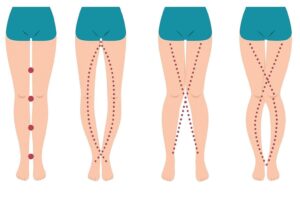
In a perfectly neutral alignment, a straight line can be traced directly from the center of the hip joint, through the middle of the kneecap, down to the ankle and space between the first two toes.
-
The Health Impact: This distribution is the gold standard for joint longevity. It ensures that weight is evenly dispersed across the ankles, knees, and hips, minimizing premature wear and tear on the cartilage.
2. Outward Bowing (Genu Varum / “Bowlegs”)
This pattern is characterized by knees that remain wide apart even when the feet and ankles are touching. The dotted lines of tension bow outward at the thighs and calves before meeting back at the base.
-
The Health Impact: Bowing often places extra pressure on the inner (medial) compartment of the knee joint. Over time, this can lead to tight outer thigh muscles (like the IT band) and elongated, weakened inner thigh muscles (adductors).
3. Inward Angling (Genu Valgum / “Knock-Knees”)
With this alignment, the knees angle inward and touch or come very close to one another, while the ankles and feet remain significantly spaced apart. The lines of force cross directly at the knee joint.
-
The Health Impact: This posture shifts structural stress to the outer compartment of the knee and can cause the arches of the feet to collapse inward (overpronation). It often stems from a combination of tight hip adductors and weak gluteal muscles, particularly the gluteus medius.
4. Recurvum and Torsion Patterns (Complex Alignment)
The final pattern illustrates a more complex, undulating alignment where the lines cross at multiple points—near the upper thighs and again near the ankles. This often points to joint hypermobility, where the knees hyperextend backward, or structural rotation (torsion) in the shinbones or thighbones.
-
The Health Impact: Hyperextension locks the knee joints out, turning off the supporting muscle groups (like the quadriceps and hamstrings) and forcing the skeletal ligaments to bear the brunt of the body’s weight.
The Hidden Connection: Lower Body Alignment and Pelvic Floor Health
It might seem like your knees and ankles are entirely separate from your deep core, but their alignment directly influences pelvic health.
The muscles of the inner thighs (adductors) attach directly to the pubic bone and share a deep fascial connection with the pelvic floor muscles.
-
How Inward Angling Affects the Basin: When knees chronically collapse inward, the inner thighs become overactive and hyper-toned. This constant pull can create chronic tension or imbalances in the pelvic floor, occasionally manifesting as deep pelvic discomfort, core instability, or poor circulation in the lower pelvic region.
-
How Bowing Affects the Basin: Conversely, an outward-bowed alignment can pull the sit-bones apart, altering the resting tension of the pelvic diaphragm. This can lead to a weakened pelvic floor, reducing its ability to effectively support internal organs.
Three Steps to Restore and Support Your Alignment
If you notice your body naturally falls into an inward, outward, or hyper-extended pattern, you can use targeted movement strategies to bring your structure back into a healthier balance.
1. Build Foot Awareness (The Tripod Base)
Every alignment pattern starts at the feet. Practice standing with your weight distributed evenly across three points: the base of your big toe, the base of your pinky toe, and the center of your heel. Keeping these three points grounded prevents the arches from collapsing inward or rolling outward.
2. Balance the Thighs
-
For Inward Collapse: Focus on strengthening the lateral glutes with exercises like clamshells, side-lying leg lifts, or banded squats. Concurrently, stretch the inner thighs to release the inward pull.
-
For Outward Bowing: Prioritize inner thigh activation by squeezing a soft Pilates ball or yoga block between your knees during bridges or squats to wake up the adductors.
3. Unlock Your Knees
If you tend to hyperextend your legs, practice standing with a “micro-bend” in your knees. Keeping the joints soft forces your muscles to engage, improving local circulation, building lower-body endurance, and protecting your joints for the long haul.
By paying attention to these structural cues and supporting your body with balanced movement, you can improve your posture, protect your joints, and optimize your foundational wellness from the inside out