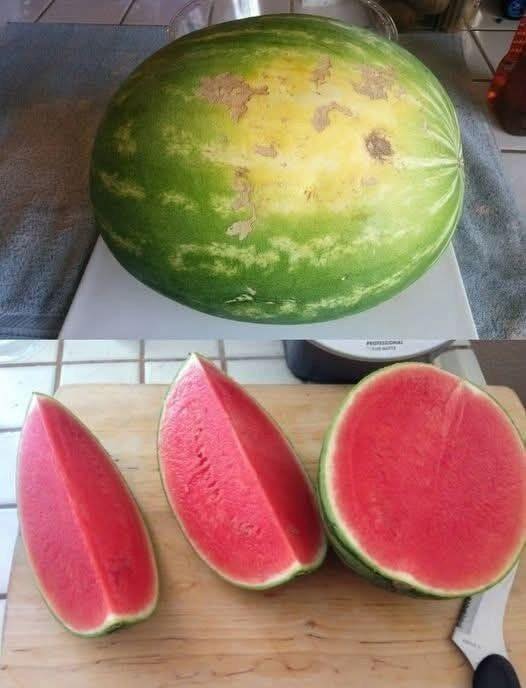
3. The Weight Test: Heavy Means Juicy
Pick up two watermelons of roughly the exact same physical size and compare how they feel. You want to select the one that feels surprisingly heavy for its dimensions.
Watermelons are roughly 92% water. A melon that feels like a lead weight is holding onto its maximum water weight, meaning the internal flesh is dense, crisp, and bursting with juice. A lighter melon of the same size has begun to dry out internally, which creates a soft, mealy, and fibrous texture.
4. Master the Sonic Thump
The “thump test” is the most famous watermelon trick, but it is frequently misunderstood. People often knock on a melon without entirely knowing what frequency they are listening for.
To do it right, lift the melon up slightly or press your ear close, and give it a firm rap with your knuckles.
-
-
A high-pitched, metallic “ping” means the rind is too thick and the flesh is under-ripe and hard.
-
A dull, heavy, thudding sound indicates an over-ripe, mushy melon that is starting to go bad.
-
A deep, hollow, resonant “pong” — like a drum or a basketball bouncing on hardwood — means the melon is at peak structure, filled with juice, and perfectly ripe.
-
5. Check the Tail and the Sheen
Finally, give a quick look at the two extremities of the fruit: the stem and the overall skin finish.
-
The Stem: If the watermelon still has a piece of its stem attached, look at the color. A green, flexible stem means the melon was harvested too early while still growing. You want a brown, shriveled, dried-out stem, which proves the vine naturally naturally completed its growth cycle and let go of the fruit.
-
The Finish: A shiny, polished skin looks pretty under supermarket lights, but it denotes an under-ripe melon. Look for a dull, matte finish. The shiny coating is a natural wax that wears away into a dull texture as the fruit reaches full maturity.