The $100 Shoplifting Riddle: How Much Money Did the Shop Owner Really Lose?
Sometimes, the simplest math problems can confuse even the smartest people. This tricky money riddle has been making people argue online because the answer isn’t as obvious as it first appears!
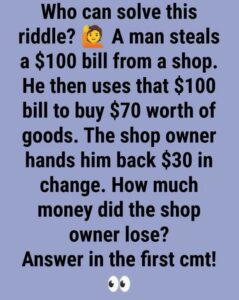
Imagine a man walks into a shop and steals a $100 bill from the cash register. A few minutes later, he returns to the same shop and uses that exact $100 bill to buy $70 worth of goods. The shop owner accepts the payment and gives the man $30 in change.
Here’s the big question: How much money did the shop owner lose in total?
At first glance, you might think the answer is $100, $130, or even $170. But before you decide, let’s break down what actually happened.
Step-by-Step Explanation
Step 1: The initial theft
The man steals $100 from the shop. At this point, the shop owner is down $100 in cash.
Step 2: The money comes back
The man uses the stolen $100 bill to pay for his $70 purchase. The shop owner receives the $100 bill back, so the original cash loss is recovered.
Step 3: The shop owner gives change
The owner hands over $30 in change and gives the man $70 worth of goods.
Now consider what the owner has lost:
- $70 worth of goods sold to the thief.
- $30 in cash given back as change.
Add those two amounts together:
$70 + $30 = $100
The Final Answer: $100
The shop owner loses $100 in total: $70 in merchandise and $30 in cash.
The stolen $100 bill itself isn’t counted twice because it returns to the shop when the man pays for his purchase.
Why This Riddle Tricks So Many People
The secret is to follow the money instead of counting the same $100 bill multiple times. The thief initially takes $100, but that same money returns to the owner’s possession during the transaction. The owner’s final loss consists of the goods and the change handed to the thief.
It’s a simple example of how a small twist in a story can make an easy calculation surprisingly confusing!
Now it’s your turn: Did you get the answer right on your first try, or did this riddle trick you too? Share your answer in the comments and challenge a friend to solve it without looking at the explanation.