How to See Both Women
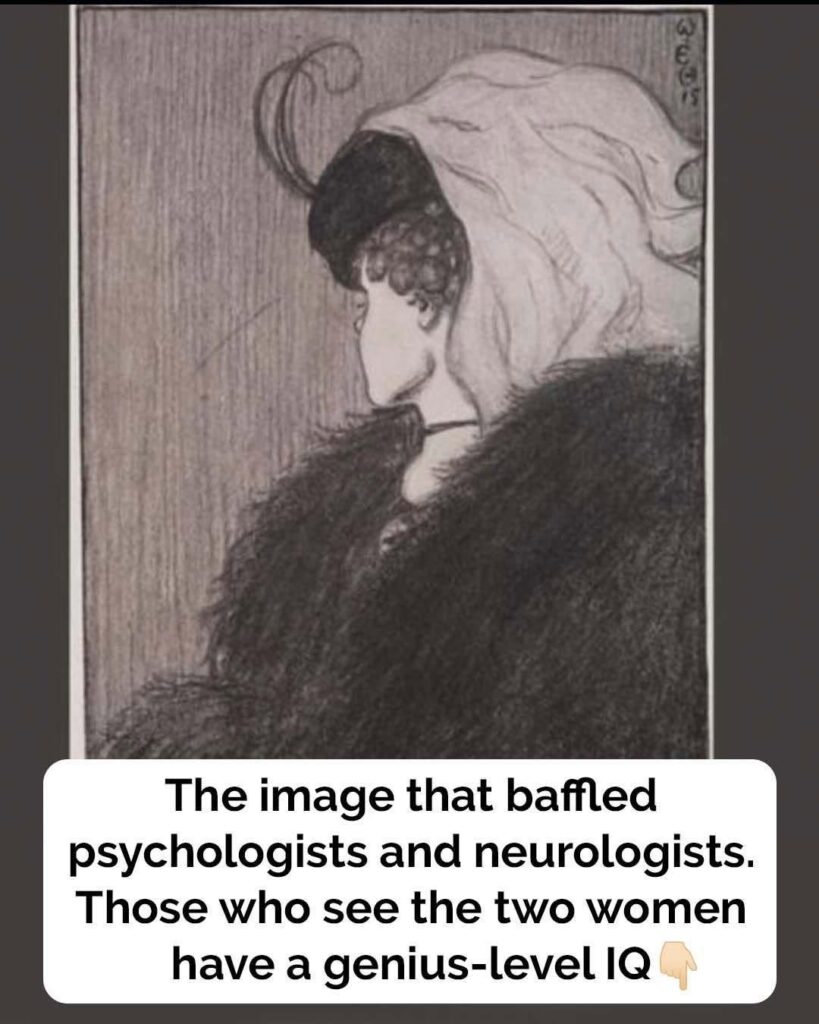
If your brain is currently stuck looking at just one lady, don’t panic. The image is a masterful exercise in dual perspectives. It features a young woman looking away into the distance, and an elderly woman looking downward in profile.
Here is the ultimate cheat sheet to shift your perspective:
1. Finding the Young Woman (The “Wife”)
-
Look at the center of the image. The young woman is facing away from you, looking over her right shoulder.
-
You are looking at her jawline and a tiny bit of her nose profile.
-
She is wearing a fashionable hat with a feather and a dark choker around her delicate neck.
2. Finding the Elderly Woman (The “Mother-in-Law”)
-
Now, let’s switch gears. The young woman’s elegant jawline is actually the elderly woman’s large, prominent nose.
-
The young woman’s ear is the elderly woman’s left eye.
-
The dark choker around the young woman’s neck? That is the elderly woman’s mouth, tucked into her fur coat.
-
The young woman’s cheek and profile become the entire side of the older woman’s face as she looks down somberly.
The Actual Science: Why It Tricks Your Brain
So, why does the internet claim this image “baffles” scientists? While it doesn’t leave them completely clueless, it does beautifully illustrate a fundamental concept in psychology called Gestalt perception.
Your eyes are merely cameras collecting raw data (lines, shadows, contrasts), but your brain is the editor that interprets that data to create a coherent story. Because the lines in this drawing are perfectly ambiguous, your brain cannot process both images simultaneously. It has to make a snap executive decision.
Once your brain selects an interpretation—say, the young woman—it creates a mental framework. It says, “Okay, this line is a jawline.” To see the older woman, your brain has to actively tear down that framework, override its initial bias, and reassign a completely new meaning to those exact same lines.
Interestingly, a famous 2018 psychological study even suggested that age plays a role in what you see first. Researchers found that younger participants tended to spot the young woman first, while older individuals were quicker to recognize the elderly woman, suggesting our brains subconsciously prioritize faces that mirror our own age demographics.
The Takeaway
While spotting both women might not automatically qualify you for a Nobel Prize or prove a “genius IQ,” it doesdemonstrate excellent cognitive flexibility.
Being able to flip back and forth between the two images means your brain is highly capable of shifting perspectives and looking past its initial assumptions—a pretty great trait to have, both in optical illusions and in life.