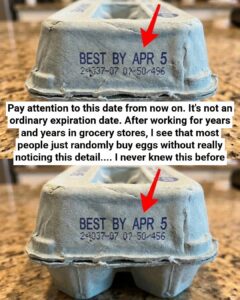
When walking down the dairy aisle, most shoppers perform a quick, subconscious ritual: grab a carton of eggs, flip open the lid to check for cracks, look at the “Best By” date, and toss it into the cart.
But according to veteran grocery store workers, the standard calendar date printed on the cardboard isn’t the most accurate way to measure how fresh your eggs actually are. To unlock the true history of your food, you need to ignore the month and look closely at the cryptic strings of numbers stamped directly beneath it.
The Myth of the “Best By” Date
The “Best By,” “Sell By,” or expiration date stamped on a carton is primarily a tool for grocery store inventory management, indicating how long a product should remain on retail shelves.
These dates are not federally mandated for eggs and are often governed by varying state-level marketing laws. In fact, if stored continuously in a proper refrigerator, eggs remain perfectly safe and high-quality for three to five weeks past the stamped expiration date.
Decoding the Julian Date: The Real “Pack Date”
If you look below the “Best By” text on a standard egg carton, you will see a series of numbers. Hidden inside that string is a three-digit code known as the Julian Date.
Unlike our standard calendar, a Julian calendar tracks the consecutive days of a single year, starting with January 1st as 001 and ending with December 31st as 365.
This three-digit sequence represents the exact day the eggs were washed, graded, and physically packed into the carton at the processing facility.
How to Read It on the Shelf: