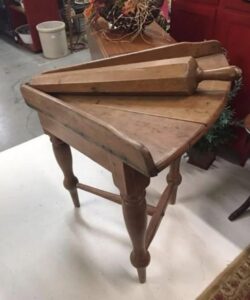
If you’ve been browsing antique shops, estate sales, or historical museums and stumbled upon a peculiar, pie-shaped wooden table topped with a massive, multi-sided rolling pin, you aren’t looking at an odd piece of living room furniture. You have unearthed a fascinating piece of culinary history: a traditional Southern Biscuit Brake (sometimes called a biscuit table or beaten biscuit machine).
Long before the invention of modern chemical leaveners like commercial baking powder, baking soda, or electric stand mixers, baking light, airy biscuits required an immense amount of physical labor. The biscuit brake was the ultimate 19th-century labor-saving kitchen appliance, engineered specifically to tackle the grueling task of making traditional “beaten biscuits.”
The History Behind the Tool
To understand why this table exists, you have to understand the traditional American beaten biscuit. Unlike modern biscuits, which are flaky, tall, and leavened with baking powder or buttermilk, authentic beaten biscuits are small, dense, slightly crisp, and break apart almost like a heavy cracker or a sturdy roll.
Because early bakers lacked yeast or chemical rising agents, the only way to get a biscuit dough to rise was to physically force air into it. Traditionally, a baker would place dough on a thick tree stump or marble block and beat it with a heavy iron mallet, a flat iron, or even the back of an axe for 30 to 45 minutes—or until the dough literally began to blister and snap with air pockets.
In the mid-to-late 1800s, inventors sought to spare bakers’ arms and shoulders by creating the biscuit brake. This specialized table allowed the cook to fold and roll the dough under an incredibly heavy, faceted wooden roller, mimicking the pounding action in a fraction of the time and with far less strain.
Anatomy of a Biscuit Brake
As seen in the image, a classic beaten biscuit table is beautifully utilitarian:
-
The Triangular/Pie-Shaped Table: The unique shape allows a baker to stand comfortably at the wide end while handling the dough. The raised wooden lips along the sides prevent the dough from sliding off.
-
The Faceted Roller: Unlike a smooth, modern rolling pin, the roller on a biscuit brake is heavy, thick, and carved with distinct flat ridges (usually octagonal or hexagonal). These ridges act like teeth, deeply crimping and pounding the dough rather than just smoothing it out.
-
The Pivot Point: The narrow end of the rolling pin is typically pinned down or hinged at the apex of the table, allowing the baker to swing the heavy roller in a smooth, sweeping arc across the surface.
How to Use a Traditional Biscuit Brake
If you are lucky enough to own a restored, food-safe antique biscuit brake, or simply want to know how our ancestors operated this unique machine, here is how the process works: